
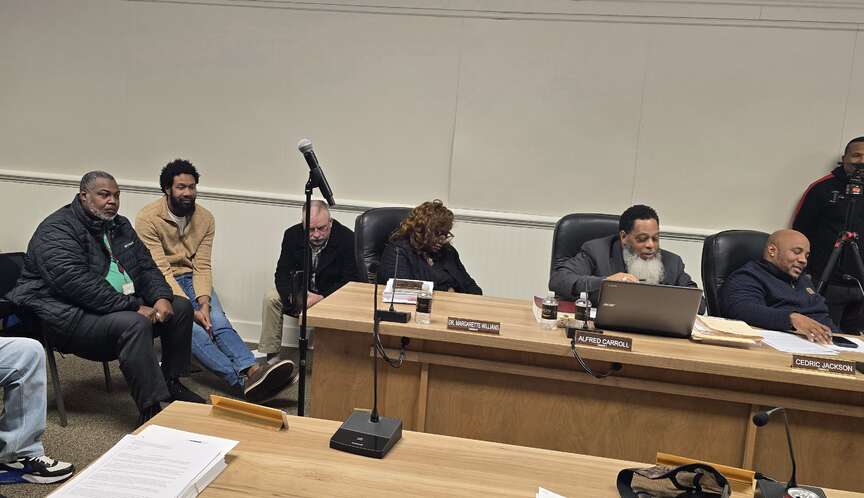
In a tale of discord, the Jefferson County Quorum Court is plagued by chaos as elected officials and County Judge Gerald Robinson clash, delaying the passage of a budget for 2025.
Jefferson County’s government employees remain unpaid, since the end of last year, as the county budget failed to pass for the third time during a special meeting on Monday night.
An attempt to call a special meeting by Quorum Court members on Thursday to address the budget was immediately shut down by Robinson, who said in an email the meeting was without his consent.
“Justices this meeting is without my consent, (Arkansas Code Section) 14-14-904 in Judge (Randy) Wright’s ruling recites the law, that you cannot meet with more than a Quorum without the judge’s consent,” Robinson wrote. “We also have a procedural ordinance in place. That outlines the agenda comes from my office, which this one that you scheduled to meet on does not! Also you are still presenting a budget that has been Vetoed and failed to override by the Quorum court. Also this budget has not been approved by the Budget and Finance committee. It is still evident that what is presented contains illegal raises given by each constitutional office, except the Sixth Division and my office. There’s also unauthorized slots added to a number of offices. One in the County Clerk’s office, especially a legislative clerk, which is already in my office.”
Independent reporting for Pine Bluff & Jefferson County since 1879.
Robinson was referring to Special Judge Randy Wright, who ruled in Robinson’s favor Dec. 26 in a lawsuit Robinson filed against members of the Quorum Court over a variety of procedural matters in the Second Division of the 11th West Circuit.
The proposed budget ordinance submitted by the JPs authorizes the county judge to approve the budget and directs the county treasurer to transfer funds between specific funds to support various programs and services. This includes transferring funds from Public Safety/Sales Tax, Solid Waste and County General funds to support Juvenile Justice, Solid Waste Contract and Jury Fees funds, respectively.
Additionally, the treasurer is to allocate funds for the MECA (Metropolitan Emergency Communications Association) budget from sources like the County General Fund, 911 Emergency Fund and CMRS Fund. Other fund transfers support the Adult Jail, District Court and various county operations.
The ordinance also stipulates that the County Casino Revenue Fund should be split equally between the County General Fund for operational costs and the Jefferson County Emergency Reserve Fund. Further fund transfers from Treasurer’s Automation, Detention Facilities M&O Reserve and Recorders Cost accounts, among others, are directed to support the County General Fund.
Robinson halted the implementation of the proposed budget until certain legal challenges were resolved. Robinson’s budget, however, rescinds some of the legal challenges he said he feels are necessary. This decision not to pass a budget has further complicated matters, as essential services are beginning to suffer and services provided to the county are being shut down due to non-payment to vendors.
At the heart of the discord are the raises that Robinson said were illegally given to deputy chiefs of each department. If Robinson’s budget is approved, it would rescind those raises. In a previous interview, Robinson said he had no problem with the raises but that they needed to be done legally.
Last year, the Quorum Court approved a raise for the deputy chief positions to $80,000 in the county judge’s office and the Circuit Court’s Sixth Division. According to the 2024 Association of Arkansas Counties Jefferson County Government Salary Survey, the County Judge’s Administrative Assistant (Deputy Chief) salary is $80,000.
“My chief deputy’s salary was not only brought up to what the salary survey indicated, but before her raise, she had two employees under her making more than she was,” said Robinson. “She is also the supervisor of 92 people, unlike the chief deputies in the other departments.”
According to documents obtained by The Commercial, the following department’s chief deputy positions were raised to $77,530.64 from $63,964.55:
Circuit Clerk;
County Clerk;
County Assessor;
Tax Collector;
Treasurer;
District Court One;
Prosecuting Attorney.
According to the 2024 salary survey, position pay for those slots should be $63,964. The Prosecuting Attorney and District Court One offices were not included in the survey.
In the sheriff’s department, the office manager’s pay was raised from $65,411.29 to $80,000; the juvenile administrator from $70,000 to $80,000; and the jail administrator from $74,000 to $80,000.
According to the salary survey, the pay for an office manager should be $65,412; juvenile administrator $70,000; and jail detention facility administrator $74,000.
According to govsalaries.com, for employees who work for the county, the average annual salary is $22,872.
Tiffany Lowery, chief deputy in the county clerk’s office said on The Commercial’s Facebook page that several employees in most of the offices where the raises were given were cut over the years. That meant more work for the remaining employees where an increase may be warranted.
“Our office have seven employees besides the elected official but we also have five empty desks from cuts over the years,” she said. “The county judge is quick to ensure the public is aware of raises we received, but everyone is missing the fact that his chief deputy received almost a $16,000 increase first which brought her pay to $80,000.”
According to Lowery, the employee in Robinson’s chief deputy position has only been there for two years while most of the other chief deputies have been working for the county for almost 10 years.
“If you are going to take the illegal ones, then that means everyone including his chief deputy because according to the county attorney, the budget for last year was not proper,” she said.
In previous Quorum Court meetings, both County Attorney Terry Wynne and Prosecuting Attorney Kyle Hunter stated that due to Wright’s ruling, anything that was done during that period could be called into question since there was not a policy and procedure ordinance in place.
Wright found that the Quorum Court violated Section 14-14-904 of Arkansas law, which states the justices “shall assemble and organize as a county quorum court body on the first regular meeting date after the beginning of the justices’ term in office …” and that “the Quorum court of each county shall determine at the first regular meeting its rules of procedure … .”
The county has operated without rules of procedure since the start of 2023, which has often led to clashing agendas from Robinson’s office and the county clerk’s office and kept many operations of the Quorum Court – including invoice payments – on hold.
“…(T)he justices of (the) peace present failed to follow basic procedure by attempting to waive formal reading of a proposed ordinance for purposes of placing the ordinance on second and third reading, and thereby allowing for the vote of the ordinance at the June 26, 2023, meeting,” Wright said in his ruling. “At the time of the vote on the suspension of the rules there were only 7 members present in the body of Jefferson County Quorum court. The Court finds Arkansas law is clear that to suspend the rules of formal reading of the ordinance requires a 2/3 majority vote of approval by the Quorum Court as a whole, which would have required 9 members present and voting. The Court finds that the procedural ordinance, Ordinance 2023-5, was not properly presented and was not properly approved or enacted.”
The budget impasse, brought on by the inability of county government to perform what could be seen as the simplest task, has had an immediate impact on the employees who have not been paid since the end of December.
As rumors spread that some officials had clandestinely awarded others significant pay increases in their departments, documents obtained by the Pine Bluff Commercial showed that several offices gave almost every employee a raise between $1,500 to $7,500, including the sheriff’s department and the prosecuting attorney’s office.
In a previous interview with Jefferson County Sheriff Lafayette Woods Jr., he said his 2025 budget proposal was within the required 90% of funds available as well as for those of the other department heads.
The Quorum Court, not Robinson, should determine the budget, according to former Justice of the Peace Lloyd Franklin II, whose influence is still felt at current Quorum Court meetings. Franklin has previously stated that Robinson cannot dictate the budget of another elected official.
“The budget presented by the Quorum Court allows every elected official to have what they need to run their department,” said Franklin in a previous interview. “We even gave the judge everything he asked for. We didn’t touch his proposed budget.”
As days have turned into weeks, the budget remains in limbo. Robinson is seeking an imminent resolution and has remained unwavering in what he says is his commitment to uphold the law. Quorum Court members are divided — with some siding with the county judge and others forever at odds with him — as elected officials dig in their heels demanding transparency and accountability.
Robinson said he intends to call a special meeting within the next week to address the situation.
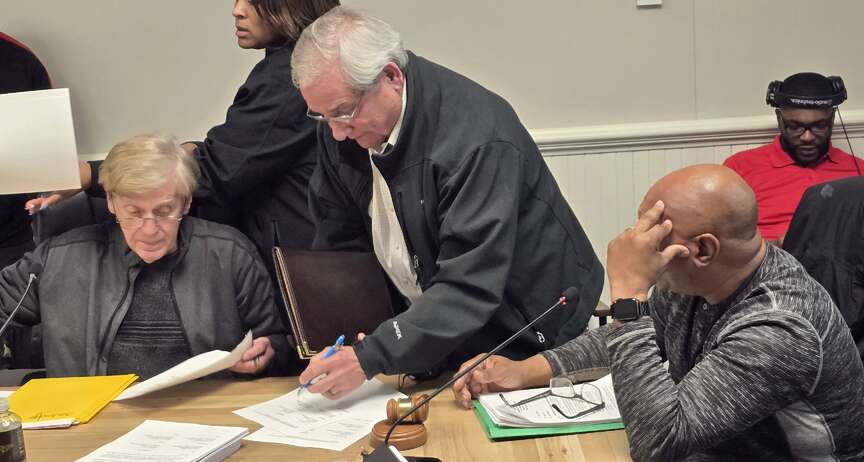 County Attorney Terry Wynne signs off on an ordinance after the Jan. 13 Quorum Court meeting. (Pine Bluff Commercial/Eplunus Colvin)