
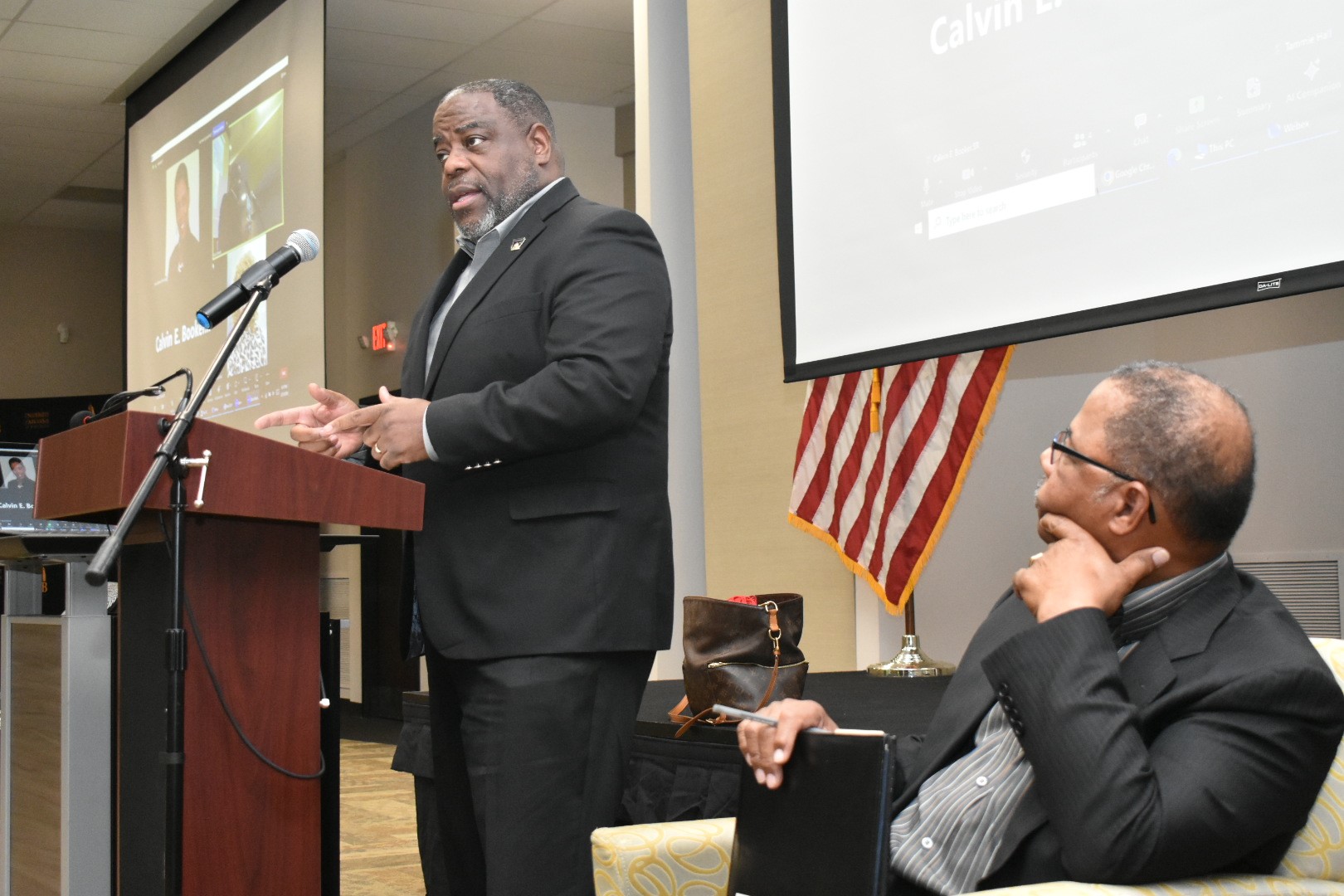
State legislators and a leading alumnus of the University of Arkansas at Pine Bluff discussed recent steps in their pursuit of reclaiming more than $330 million for the university under the Second Morrill Act of 1890.
State Rep. Vivian Flowers, D-Pine Bluff, hosted a town hall meeting at the university’s Science, Technology, Engineering and Mathematics Conference Center on Wednesday to update how members of the Arkansas Legislative Black Caucus and past presidents of the UAPB National Alumni Association have worked to bring a resolution to the lack of funding that has plagued the state’s only public historically Black university.
UAPB has been funded inequitably compared to the University of Arkansas, Fayetteville, according to the National Center for Education Statistics’ Integrated Postsecondary Education Survey. The U.S. Department of Education and the U.S. Department of Agriculture cited data from the study to report a UAPB shortfall of $330,935,712 between 1987 and 2020 in comparison to UA-Fayetteville, according to a letter the department secretaries issued to Arkansas Gov. Sarah Huckabee Sanders in September 2023.
Though UAPB was founded in 1873, the federal act from 1890 provided that states either establish a second land-grant institution for Black students or prove that admission to the first land-grant schools, established under the First Morrill Act of 1862 for the purpose of agricultural and mechanical studies, was not restricted by race. UA-Fayetteville was founded in 1871 under the First Morrill Act.
“The USDA letter was a long time coming,” said Flowers, a candidate for mayor of Pine Bluff.
Independent reporting for Pine Bluff & Jefferson County since 1879.
State Rep. Reginald Murdock, D-Marianna, vice chairman of the Legislative Black Caucus, said work has been done, is being done and will be done in hopes of securing the missing funding, adding that caucus members were happy just to receive “crumbs” of funding for UAPB from past administrations.
“There is acknowledgement that something is due, and it’s even law,” Murdock said. “We’ve always had a contingency at the Capitol fighting for that money.”
The Washington Post reported in September that 16 states, including Arkansas, were found to have underfunded the historically Black land-grants by an estimated $12.6 billion combined. The newspaper reported that Maryland in 2021 agreed to a $577 million court settlement with its four historically Black universities, adding that its Black land-grant, the University of Maryland Eastern Shore, received $3,397 more per student than its original land grant, the University of Maryland, in 2020. Closer to Arkansas, a recent assessment by the federal government revealed that Tennessee State University was underfunded by $2.1 million, according to reporting by The Tennessean newspaper of Nashville.
The Tennessee Legislature designated $250 million for Tennessee State University in 2022 in response to a 2021 audit that showed the school was underfunded by up to $544 million between 1957 and 2007, according to reports.
Murdock said Sanders has shown interest in addressing the UAPB shortfall. Despite that, legal action to recoup the $330 million is not out of the question, he suggested.
“I truly believe there will have to be a legal arm at some point, because it’s a big number,” he said.
Timothy Pighee said he hand-delivered a letter to a member of Sanders’ staff requesting a meeting between her and fellow past presidents of the National Alumni Association.
“We want to see what her thoughts are,” Pighee said. “From that meeting, our group will determine the next steps.”
Students in attendance said they need immediate fixes to poor housing conditions on campus, although Flowers encouraged them to use their voice in the battle to close the funding gap. She added that more data are needed to establish a timeline for the next steps.
“We are eager and ready to fight with you all,” Student Government Association President Trenton Wills said. “We want to make sure we’re informed before we go to a fight. We want to fight for future generations. We want this university to be here for another 150 years.”
UAPB Chancellor Laurence B. Alexander outlined other needs that the $330 million could address, including new residence halls, renovations to existing residence halls, and a renovated interior for Hazzard Gym, where the ROTC is headquartered.
“When students are living in better conditions and better housing, when they’re satisfied, when we have a high level of student satisfaction with the housing, I am hopeful that would also have a greater impact on their student success and achievement and their success beyond their time here at the university,” Alexander said. “… We need more spaces where students can gather, engage with each other and faculty and staff. There is a great need for addressing facilities and improving facilities.”
The university has broken ground on a planned soccer/track facility and student union in recent years, but those projects have been stuck in early phases and could use some of the missing funding, Alexander believes.
When Alexander was asked about the sports facility, he said school officials have been “value-engineering that project, which means doing things inside that will reduce the cost because we just don’t have the funding to do all the things that were envisioned in the plan and that students had a hand in envisioning.
“We will be able to get most of the things now, but [the funding] would bring the project along faster,” he added. “It would help to bring about a vision and upgrade the campus as a whole so that it looks as good, if not better, than many of the campuses we see across the state.”