
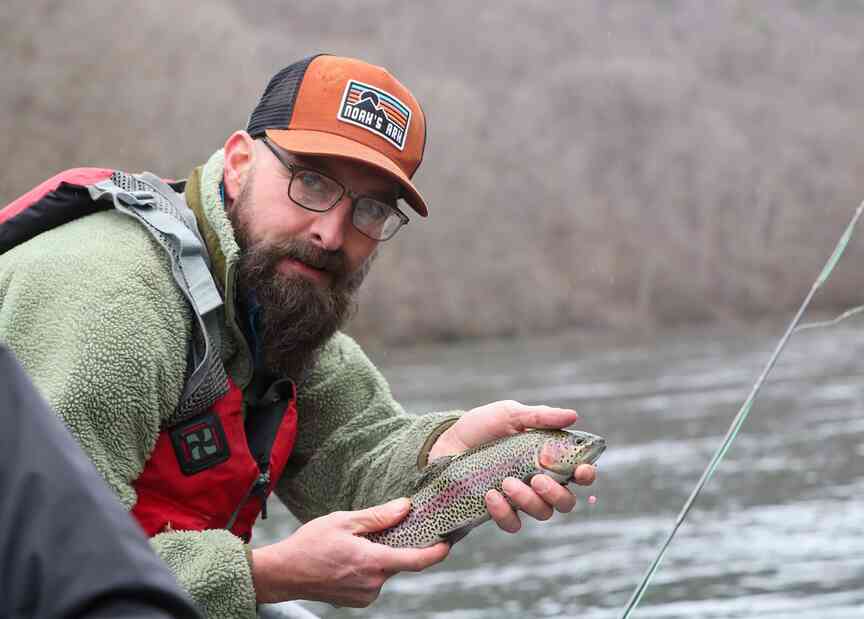
The Arkansas Game and Fish Commission unanimously voted at its monthly meeting to adopt limits on four of Arkansas’ famous trout tailwater fisheries. The Jan. 15 meeting was held at the agency’s headquarters.
Trout anglers on the White River from Bull Shoals Dam to the Norfork Access and on the North Fork River from Norfork Dam to the Norfork Access will be able to keep two rainbow trout under 14 inches. All other trout species must be released immediately in these waters.
On the White River from the Norfork Access downstream to the Arkansas Highway 58 bridge, the daily limit will be two trout of any species, with only one over 14 inches allowed. On the Beaver and Greers Ferry Tailwaters, the daily limit will be two trout of any species and any trout longer than 14 inches must be released immediately. All of these regulations will become effective Feb. 1, and will remain in effect until further notice.
This change was enacted to encourage trout fishing on these waters following a temporary emergency order to reduce trout harvest on stocked Arkansas waters in response to shortages at federal and state hatcheries last year. Both the Norfork National Fish Hatchery and the commission’s Jim Hinkle Spring River State Fish Hatchery underwent unforeseen die-offs and infrastructure failures due to natural events, nearly wiping out their production. Commissioners placed a temporary restrictive limit system on the waters dependent on these stocked fish as a proactive measure until the scope of the loss could be evaluated.
The commission also unanimously approved fishing limits on Lake Monticello in southeastern Arkansas. Effective Feb. 1, anglers will once again be able to keep a few fish from the recently renovated lake that’s known for trophy-sized largemouth bass and plentiful crappie.
Independent reporting for Pine Bluff & Jefferson County since 1879.
Following a drawdown and renovation of the lake’s dam by the city of Monticello, the lake has been stocked with standard Florida bass from commission hatcheries, as well as a special line of Florida bass titled “TITAN MAXX” from Red Hills Fishery in Georgia that have been identified on a genetic level as having the traits to grow to trophy sizes. It has also seen heavy stockings of forage species to encourage the growth of game fish species while the lake is experiencing a “new lake effect” boom in productivity. Fish well over 5 pounds and some reaching the 8-pound mark have already been caught in the lake. Data suggests that some harvest of smaller largemouth bass will help the fishery by reducing some of the feeding pressure on forage, allowing larger fish to continue growing. Anglers will now be able to keep up to five fish per day, with only one of those fish being over 16 inches long.
In addition to bass harvest, anglers will be allowed to keep up to 15 crappie to help balance the growing population of this game fish in Lake Monticello. Only seven crappie may be 12 inches or longer to keep, however.
“Data suggests that the crappie population is beginning to become overabundant, and some limited harvest of this species will help keep the lake’s food chain balanced,” said Tommy Laird, chief of the commission’s Fisheries Division.
All other species on Lake Monticello will also be allowed for harvest following statewide daily limits for those species.
AGFC COLONEL
Game and Fish Commission Director Doug Schoenrock formally recognized Joe Williams as the Enforcement Division’s colonel, a promotion he received in early December.
“Joe was 12 years old when he decided he wanted to become a game warden,” Schoenrock said. “While fishing with his dad in Jones Lake over at (Felsenthal National Wildlife Refuge), a local game warden at the time checked his father’s fishing license, and after the warden left, his father suggested, ‘Joe, this would be a good career for you.’ … Joe became a game warden in 2009. He was assigned to Ashley County for 13 years, where, of all things, his first partner was the late retired director and former colonel, Pat Fitts.”
Williams was promoted to sergeant in 2018, then captain in the Mountain Home office in 2021, before attaining the rank of lieutenant colonel last year and ultimately colonel and head of the commission’s Enforcement Division.
REGULATIONS SETTING PROCESS
During the Jan. 14 committee meetings, staff gave a preliminary report on the upcoming regulations-setting process. Commission Deputy Director Brad Carner also led a presentation on the scope of regulations change proposals.
“We have worked very hard to continue reducing and simplifying regulations wherever we can,” Carner said. “We’ve heard from all of the commissioners to take the steps necessary to consolidate and eliminate regulations to make things easier to understand for the general public, and biologists have been focused on this effort during the last two years. We’re proud to say we have already identified more than 40 regulations that we plan to eliminate, and many instances where we can consolidate regulations to add consistency for our hunters and anglers.”
Commissioners will review the preliminary proposals until the agency’s scheduled meeting, Feb. 19, at which time the staff will make formal recommendations for regulation changes. A public survey is planned the Friday following that meeting to gather comments and input on the changes. A final vote on the regulations is expected in April.
OTHER BUSINESS
The commission also:
• Recognized commission printer Scotty Quarles for his quick actions in saving the life of a co-worker who was choking. Quarles performed the Heimlich maneuver three times to dislodge the blockage in the man’s airway, allowing him to regain his breath. In addition to the award, Director Schoenrock committed to adding life-saving devices to assist with choking victims throughout agency facilities.
• Heard a presentation from commission private lands habitat biologist Jeff Lawson, who talked about broad-scale habitat conservation and the importance of regional and national partnerships such as habitat joint ventures to deliver the wide-scale habitat improvements needed for many native wildlife species, including Neotropical migratory songbirds, shorebirds and waterfowl.
A video of the meeting is available on the Arkansas Game and Fish Commission’s YouTube Channel.