
Most conversations about plants in ponds revolve around how to remove or prevent them from growing there. In these situations, pond owners are often dealing with fast-spreading plant species in a small, shallow body of water that can be easily overrun if they are neglected.
However, with proper care and species selection, aquatic plants can provide spectacular function and beauty to ponds, according to Scott Jones, small impoundment extension specialist at the University of Arkansas at Pine Bluff.
BENEFITS OF AQUATIC PLANTS
Excluding a few industrial, commercial, municipal water storage and treatment roles for which some ponds are built to fulfill, most ponds can benefit from some form of plant growth.
The simplest form is terrestrial grass covering pond edges, dams, levees and spillways, Jones said. The grass roots help secure the soil from erosion during rainfall and runoff and provide a visually pleasing border for the pond.
Independent reporting for Pine Bluff & Jefferson County since 1879.
“Now, imagine if we could achieve the same soil stabilization role but also add height, depth and flowers to boost visual appeal, dampen wave energy from hitting the shore, provide cover for fish and attract wildlife and pollinators to the pond,” he said. “You can achieve enhanced function and beauty. Combining plant species that utilize different water depths and that grow to differing heights can achieve this.”
EXAMPLES OF BENEFICIAL PLANTS
There are potentially dozens of plants that could provide benefit to a pond. Several species fit the criteria that are native to Arkansas, semi- to fully-aquatic, produce attractive flowers, spread relatively slowly and can provide habitat to diverse wildlife, Jones said.
“Some species may be missing one of the previous criteria, but they compensate with exceptional or unique qualities elsewhere,” he said. “Plant height is useful when creating a natural and visually appealing transition from land to water, with taller plants farther away from the water and progressively shorter plants towards the water.”
One shrub-like species, the swamp rose mallow (Hibiscus moscheutos), can grow up to 8 feet tall with very large, showy flowers and can be planted near shore in areas consistently too wet for other terrestrial species, Jones said. This plant provides great aesthetic value, is pollinator friendly and is known to attract hummingbirds.
Swamp sunflower (Helianthus angustifolius) is a low-density plant that produces flower stems 5 to 6 feet tall tipped with bright yellow flowers approximately 2 inches in diameter. This plant adds a splash of color above fully aquatic plants and is known as a favorite for native bees.
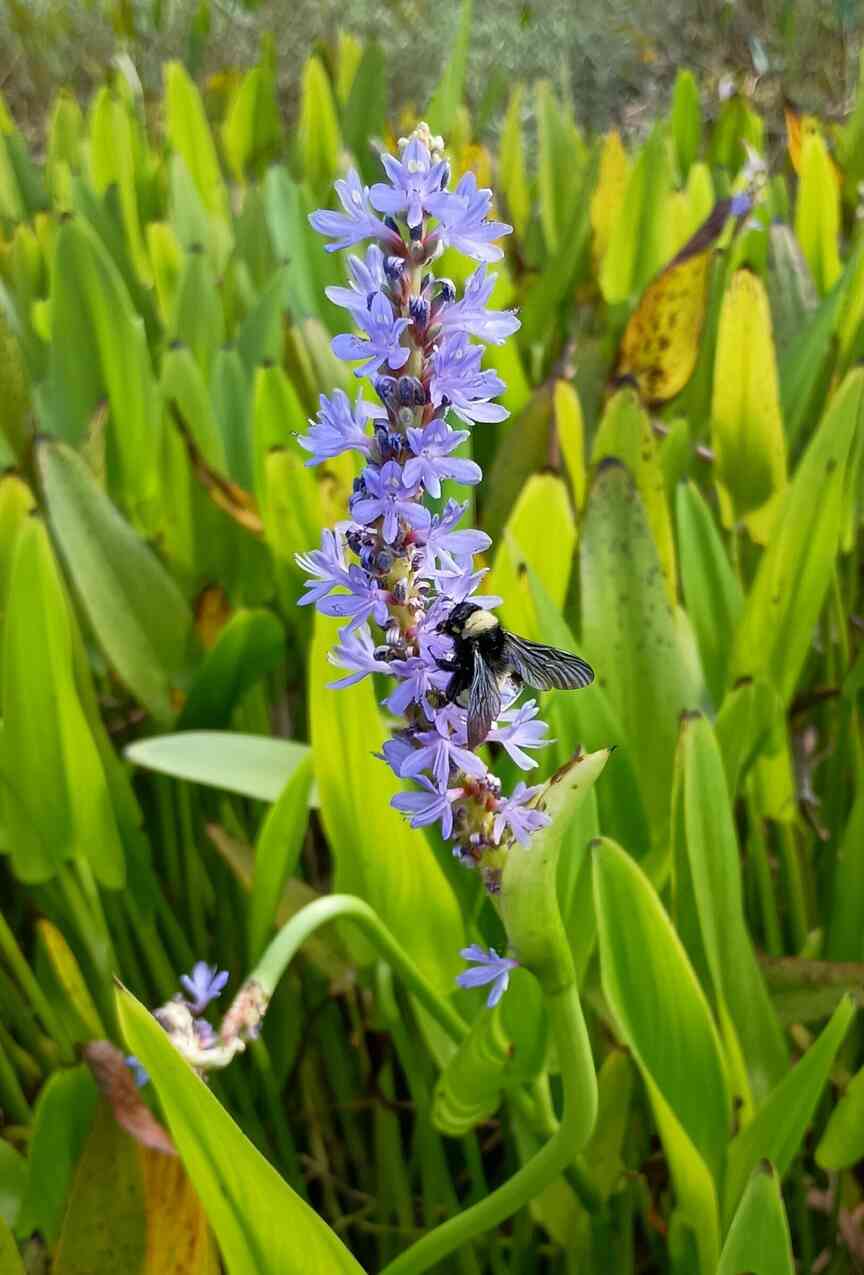
“Pickerelweed (Pontederia cordata) is one of the most frequently recommended shoreline plants. Featuring deep green waxy leaves, large flower spikes with numerous deep blue to purple flowers that bloom throughout the summer, and a moderately slow rate of spread in shallow water makes it a prime candidate for those wanting to introduce aquatic plants to their ponds or water gardens,” he said. “Pickerelweed is highly popular with numerous pollinators, waterfowl and provides some near-shore habitat for fish.”
Broadleaf arrowhead (Sagittaria latifolia) is a popular mid-height option that resembles terrestrial elephant ear. Arrowhead flowers are small but conspicuous, providing some interest from pollinators. Their main aesthetic quality comes from the large broad leaves that provide a somewhat tropical look to the shoreline, Jones said. Several species of waterfowl are highly attracted to consuming the starchy tubers of arrowhead. This may increase the abundance of waterfowl to the pond, which may necessitate installing protective cages over founder colonies to keep the fledgling arrowhead from being wiped out by hungry ducks.
“Many aquatic plants require near full sun to thrive. Owners with mostly- to fully-shaded ponds who want to introduce flowering aquatic plants should consider lizard’s tail (Saururus cernuus),” he said. “This mid-height (3 to 4 feet tall) plant spreads well in shaded moist soils and produces a unique drooping flower spike covered with numerous tiny white flowers. It is popular with pollinators and noticeably aromatic with notes of citrus.”
Southern blue flag (Iris virginica) is an aquatic from the popular Iris genus featuring large unique blue, white and yellow flowers emerging from stands of elongated leaves that grow from the water. The potentially dense, yet relatively short (2 to 3 feet) stands of blue flag leaves attract birds and provide near-shore habitat for fishes.
“Soft rush (Juncus effusus) is an excellent, albeit more utilitarian, species for pond shorelines. While it lacks attractive flowers, soft rush grows dense clusters of moderately rigid grass-like stems 2 to 3 feet tall. The density of the clusters provides good soil stabilization to reduce erosion and capture sediment from incoming runoff,” he said. “As the rush spreads into the water, it can buffer wave energy to reduce erosion on wind-blown banks. The density of stems attracts birds and provides some near-shore habitat for fishes. While there are other large grass species that are better for shoreline protection, like cattail, soft rush does not grow too tall or quickly to significantly interfere with view or access to the water like cattail and other larger rush species do.”
For those who enjoy the arrowhead and elephant ear-like plants but do not have enough sunlight to sustain them at their pond banks, try arrow arum (Peltandra virginica), Jones suggests. Similar in size, appearance and soil moisture preferences to arrowhead, but tolerant of shady conditions, arrow arum is a slow spreading aquatic plant that attracts waterfowl and can provide some near shore habitat for fishes. It has unique long-stemmed yellow flower spikes sheathed by fleshy green to white spathes.
“The plants above would be considered shoreline species; capable of living in standing water but they typically do not expand out into several feet of water. This is helpful in terms of management because it limits how far and wide they can spread,” he said. “Even beneficial species can become ‘weeds’ if they grow uncontrolled and begin interfering with the function or appearance of the pond.”
Two plant species that are fully aquatic and provide very good fish habitat are the fragrant water lily and eel grass.
Fragrant water lily (Nymphaea odorata) can grow several feet deep, sending floating leaves up to the surface on long thin stems. The leaves are up to 10 inches in diameter and almost circular with deep “v” shaped cuts to where the stem connects to the leaf. The large flowers also float on the water’s surface at the ends of thin stems, Jones said. Typically, flowers are white to pink, but several color variants have been bred by producers. Lilies provide excellent cover and shade for fish, and they spread relatively slow compared to some other lily/lotus species.
Waterfowl feed on parts of lilies, so protection may be needed until the colony is well established.
“Eel grass (Vallisneria americana) is a fully submerged plant that in clear water can grow more than 6 feet tall. It is a favorite for habitat enhancement projects by state and federal agencies for its moderate rate of spread and excellent fish attracting properties,” he said. “The grass-like leaves are about 1 inch wide growing from clusters rooted to the pond bottom.”
Eel grass is easily fished with minimal snags and lure fouling compared to other aquatic species. It is, unfortunately, highly vulnerable to turtles, grass carp and other aquatic herbivores so protective cages are essential to help establish a founder colony, Jones said.
Few if any other submerged plant species should be attempted, especially in small shallow ponds. Most submerged species quickly expand out of control and choke out shallow areas. Once out of hand, expensive herbicides and grass carp will likely be needed to regain control.
SOURCE, ESTABLISH, MANAGE PLANTS
“Many online plant nurseries offer seeds, seedlings or mature packs of aquatic plants. Some local nurseries, especially those that dabble in ornamental water gardens, may have some of the species in stock or have means to order them for you,” he said. “These vendors will have specific details on planting and care for each species.”
In most cases, it will be necessary to protect young plants from predation until a mature colony is established, Jones said. Cages can be constructed with chicken wire or similar metal to plastic mesh wrapped around PVC or metal frames and anchored to the pond bottom or shore.
“You can remove the cages later after the plants have filled that space and begin spreading outside of the cage. Some of these plants may begin spreading outside of the boundaries you want them to occupy, he said. “It is best to use weed trimmers, rakes, hoes and hand-pulling the plants that start getting out of line. Herbicides are effective, but drift may damage larger areas than you intend, and the dead plants are unsightly. Much like considering installing a new garden in the back yard, if you are not willing to maintain regular weeding duties to keep it looking nice and tidy, you may be better off not carrying out the project.”
Introducing plants to a pond can be tedious, Jones said. Producers must select species that provide benefit but do not spread excessively fast.
“You must plant them correctly and protect them from herbivory, and you may need to control them once they are fully mature and begin filling out the shoreline,” he said. “For those willing and able to handle the added effort, proper plants can add tremendous beauty and function to ponds.”
For more information about pond plants, contact Scott Jones, small impoundment extension specialist at UAPB, at (870) 575-8185 or joness@uapb.edu.
Debbie Archer is an extension associate for communications with the University of Arkansas at Pine Bluff School of Agriculture, Fisheries and Human Sciences.