
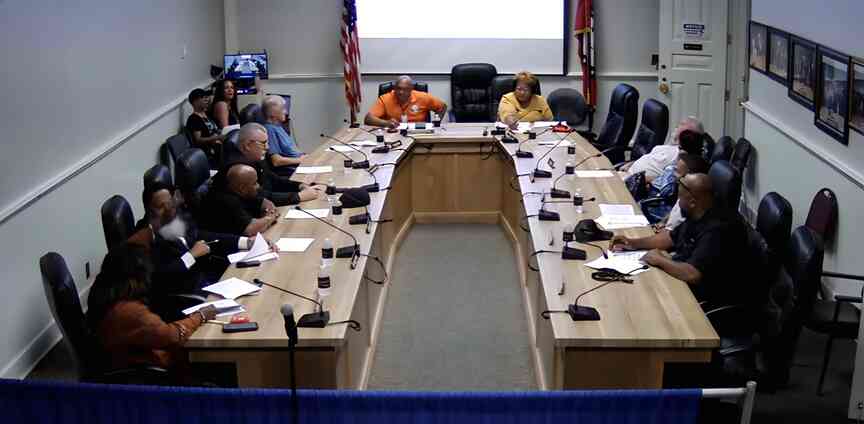
A special-called meeting of the Jefferson County Quorum Court on Wednesday was dominated by discussions over two appropriation ordinances, with one key measure ultimately failing to pass after a justice of the peace linked the vote to ongoing disputes over legal fees.
The meeting quickly focused on an appropriation ordinance seeking $149,657 within the county judge’s office (Fund 1000 County General) to cover debts in specific line items: $62,534 for computer services and $87,123 for other professional services. A motion to suspend the rules and move the ordinance to its third reading was made, seconded and then failed after a roll call vote, resulting in a debate on “New Money” vs. “Transfers.”
The debate centered on the nature of the requested funds and prior financial maneuvers. Jefferson County Judge Gerald Robinson explained that the appropriation was necessary to clear negative line items and wasn’t truly new money, but rather an allocation of existing funds. “We have sufficient cash on hand … we just need the appropriation?” he said. “So we’re asking for our money to clean up those lines so that we can. And this is what we’ve done; we’ve done this every year.”
Justice of the Peace Reginald Adams, however, pushed back on the request, asking why transfers couldn’t be used, claiming that the judge’s office had money in its fund. Robinson countered, “Even the transfers that we’ve asked for have been denied by this court. So now you’re saying I should transfer. So even the transfers have been denied.”
Robinson implied that asking for “new money” has a different approval process than a transfer. Amidst the back-and-forth on vendor payments, Robinson commented on recent payments made to a cleaning service vendor to address a delinquency. “Yes, she was paid; we had to rob Peter to pay Paul,” he said. “She is still delinquent when she is still owed money.”
Independent reporting for Pine Bluff & Jefferson County since 1879.
A request was made by Justice of the Peace Alfred Carroll to separate the vendors and itemize the expenses so that not paying one vendor wouldn’t hold up other vendors from getting paid. Robinson asked Carroll to clarify who he did not want to pay.
The core of the conflict was revealed when Carroll connected the refusal to approve the appropriation with unpaid legal expenses from an unrelated, ongoing lawsuit. Carroll was reluctant to approve the new funds while their own attorney fees from the litigation, which the judge initiated, remained unsettled. He also questioned payment to a person “acting in the place of the county attorney.”
Robinson immediately denounced the statement: “This is misleading on your part, and the public needs to know that again those attorney fees … that is in litigation,” he said.
Robinson responded by clarifying the reason for the separate counsel, stating the county attorney could not represent the Quorum Court due to a direct conflict of interest. He informed the court that the matter of who is responsible for the legal fees is still in litigation, with a hearing scheduled for January 15. Justice of the Peace Patricia Royal Johnson voiced concern over the potential repercussions of withholding payment from the vendors who had provided services to the county. Her concern was they could be sued by the vendors. Johnson expressed significant frustration with the legislative process, citing a lack of pre-meeting preparedness and communication.
“My thing is that we’ve come in here all the time and we don’t want to pay this,” she said. “We get our packets, so we’re supposed to call the elected official, the county judge, or the chairman of that board … and we get here, you don’t do everything until we get to the meeting.”
The second measure for a supplemental appropriation of $44,545 within the Road Fund (Fund 2000 Road) to cover a “lease purchase principle” deficit was also read but not voted on before the meeting concluded.