
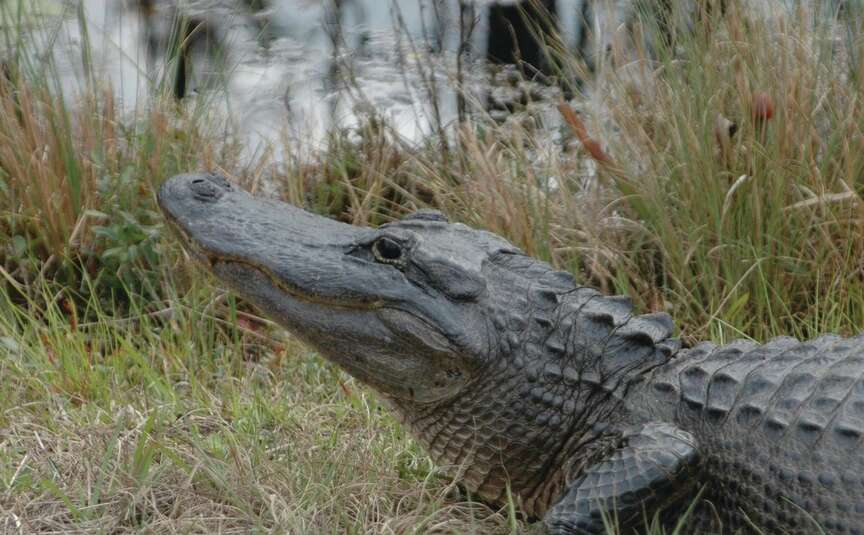
Arkansas is known as the Natural State for a reason, and the abundant wildlife is a major contributor to that reputation. Lions and tigers, not so much. Bears — sure, here and there. But for residents across the state’s southern tier, alligators make more than the occasional appearance.
In Miller County, for example, spotting the occasional reptile is just part of life. Jen Caraway, Miller County extension staff chair for the University of Arkansas System Division of Agriculture, said they’re common in areas where waterways are essential to agricultural operations.
“There’s not much you can do if you encounter one, other than stay clear and call it in,” she said.
Decades ago, American alligators (Alligator mississippiensis) in the United States were hunted nearly to extinction. In 1973, they were identified in the Endangered Species Act but were removed from the list in 1987 once their population numbers rebounded.
Becky McPeake, extension wildlife biologist for the Division of Agriculture, said alligators have managed to thrive throughout much of the South in the intervening years.
Independent reporting for Pine Bluff & Jefferson County since 1879.
“We’ve had great success reintroducing them to Arkansas,” she said. The state lies at the northern edge of the animal’s natural range, she said, and most of the northern half of Arkansas is simply too cool an environment for alligators to survive.
Sometimes, McPeake said, alligators are just part of the neighborhood, including one known specimen that nests near a site of frequent field research.
“Whenever we go out there to do any kind of research or environmental survey, the first thing we do is locate it,” she said. “Once we know where it is, we can avoid it.
“Honestly, they prefer to avoid people,” McPeake said. “It’s when they become used to being around people that they become dangerous. Some people want to feed them for some strange reason. Please don’t. It can have terrible consequences for both people and pets.”
McPeake said that if a person spots an alligator, they should stay at least 60 feet away from it, whether it’s on land or in a body of water. She said one way to keep livestock from crossing paths with alligators is to make sure they have their own secure sources of drinking water.
“We recommend that producers maintain water tanks for their livestock rather than letting the livestock drink from ponds,” she said.
In November 2023, the Arkansas Game and Fish Commission, in partnership with the U.S. Department of Agriculture, introduced a new nuisance wildlife hotline. The number, (833) 345-0315, is intended to respond to reports of wildlife that may pose a threat to people, livestock or property. The number is monitored 24 hours a day.
The commission has published annual alligator management reports since 2007 and has records of alligator nuisance reports dating back to 2000. That year, the commission received 11 nuisance reports across the state’s five alligator management zones. The number has varied from year to year, peaking in 2009 with 108 complaints across all three zones. In 2023, the commission reported 57 alligator nuisance complaints.
Among the five alligator management zones, alligator sport hunting is only allowed in the three southern-most zones (Zone 4 includes about a dozen counties in the northeastern corner of the state; Zone 5 includes most of the counties covering the northwestern third of the state).
Alligator hunting on public lands is limited to Alligator Management Zone 1, the southwest corner of the state, and Zone 3, the southeast corner of the state. The permits are drawn, so some luck is involved. Alligator hunting on private land is allowed in any of the three zones, including Alligator Management Zone 2, which encompasses more than 16 counties in central and south-central Arkansas. Private land alligator permits can be purchased outright.
The hunting dates for either permit include two four-day periods in mid-September. In 2023, Arkansas hunters set a record for the alligator harvest, bagging 202 of them on public and private lands.
To learn about extension programs in Arkansas, contact a local Cooperative Extension Service agent or visit www.uaex.uada.edu.
Ryan McGeeney is with the University of Arkansas System Division of Agriculture.
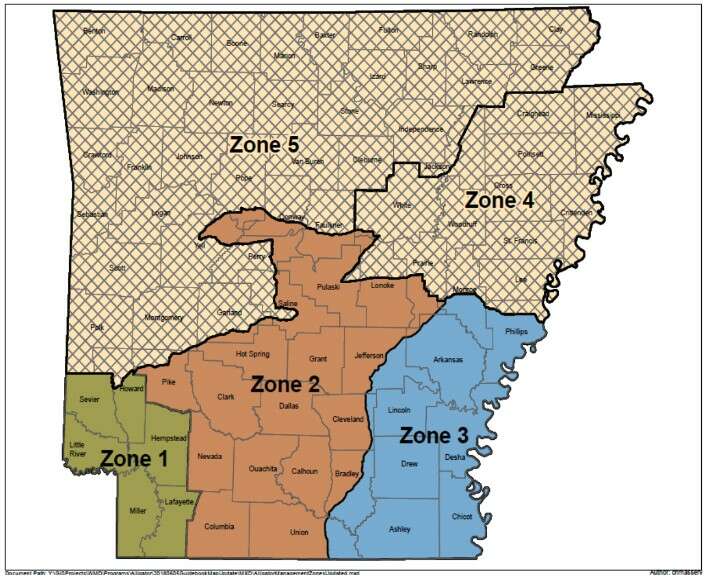 The Arkansas Game and Fish Commission has established five management zones in Arkansas, three of which allow permitted hunts in September each year. (Special to The Commercial/Arkansas Game and Fish Commission)