
After several delays in managing to fly the third aerial waterfowl survey for the 2023-24 duck season, the final report is finally available.
Although scheduled for the week of Jan. 15, weather was an issue.
“Our last period survey was later than we typically fly it,” said Brett Leach, Arkansas Game and Fish Commission Waterfowl Program coordinator. “The arctic blast locked everything up right when it was time for the flyover. We had issues with planes that wouldn’t start because of cold weather. When we tried toward the end of the week we usually do, dense fog and low ceilings made it impossible to safely fly.”
The transect flyover finally took place in two parts, with the Arkansas River Valley being flown Jan. 15-20 and the Delta from Jan. 25 to Feb. 1.
“There was considerable habitat difference from the previous survey during January 1 through 4,” Leach said,
Independent reporting for Pine Bluff & Jefferson County since 1879.
Heavy rains contributed to there being much more surface water on the landscape.
Even with the larger amount of habitat available, Leach said, “Our biologist saw a lot of clumped distribution with birds concentrated together in certain areas rather than more typically spread out.”
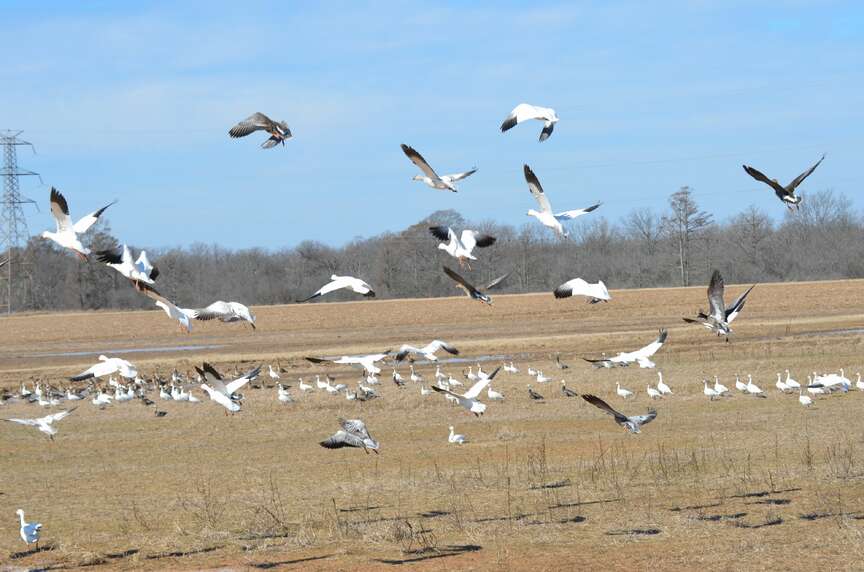
The final results are as stated. “Biologists conducting transect-based surveys in the Delta estimated 269,693 mallards and 682,089 total ducks, while duck population estimates in the Arkansas River Valley were 21,347 total ducks, including 3,841 mallards. Biologists performing cruise surveys in southwest Arkansas reported an estimated 28,200 ducks with 2,980 mallards. Arctic goose population estimates totaled 645,607 light (lesser snow and Ross’) geese and 189,406 greater white-fronted geese in the Delta.
“The Delta mallard population estimate was 510,000 mallards below the 2009-2024 long-term midwinter survey average and the lowest midwinter survey estimate on record since the start of transect based surveys. Total duck population estimates were nearly 560,000 birds below the long-term average and the lowest total duck population estimate since 2013. On average, mallards account for about 64% of all ducks in the Delta during midwinter surveys. During this survey period, mallards made up only 40% of the total duck estimate,” according to the survey.
“Biologists estimated over 40,000 mallards in three survey zones: Bayou Meto-Lower Arkansas, Black-Upper White, and Cache. … The highest total duck estimates came from the Black-Upper White and Cache survey zones. Hotspot maps indicate several key duck concentration areas primarily in the northern half of the Delta, but also good distribution throughout the central part of the Delta,” the report said.
In regard to serious concentrations of ducks reported by hunters on open bodies of water such as the Arkansas River during the extended freeze, Leach explained how due to transect surveys traversing a certain pattern over designated terrain, observations may not account for isolated concentrations found in individual areas.
The post waterfowl season conservation goose hunt began Feb. 1-2, then again Feb. 4 and goes through April 25. This opportunity for the avid waterfowler to extend sport shooting of light geese (blues, snows and Ross) goes until early spring. There are no bag limits and shotgun plugs are not required during the postseason hunt. Specklebelly (white-fronted) geese are not included in the postseason event.
The purpose of the conservation hunt is to address concerns of overpopulation among goose species.
“Light geese aren’t only a nuisance to Arkansas farmers,” AGFC’s website states. “They have become so abundant, they are destroying their nesting grounds in the Arctic Tundra. Not only are the geese eating themselves out of house and home, they’re destroying critical habitat for other species that share the Tundra. Biologists can conduct eradication efforts to balance the population, but do so only as a last resort. Increased hunting opportunity is the first wildlife management tool biologists turn to, because it costs very little to implement and is much more socially accepted than other population control measures.”
“I’ve had two students from the University of Sasakwa here this week helping try to trap and band white fronted geese,” Leach said. “We were working fields from Jonesboro to Stuttgart. It hasn’t gone too well with most of the specs having already left the region and those we found not cooperating.”
He said a lot of sportsman appear to be taking advantage of the conservation hunt.
“While we were in the field we heard a lot of banging away at snows,” he said.
Leach concluded there aren’t that many mixed flocks with specklebelly geese mingling with light geese but he cautioned hunters to be careful not to take specs while hunting snows, blues and Ross.