
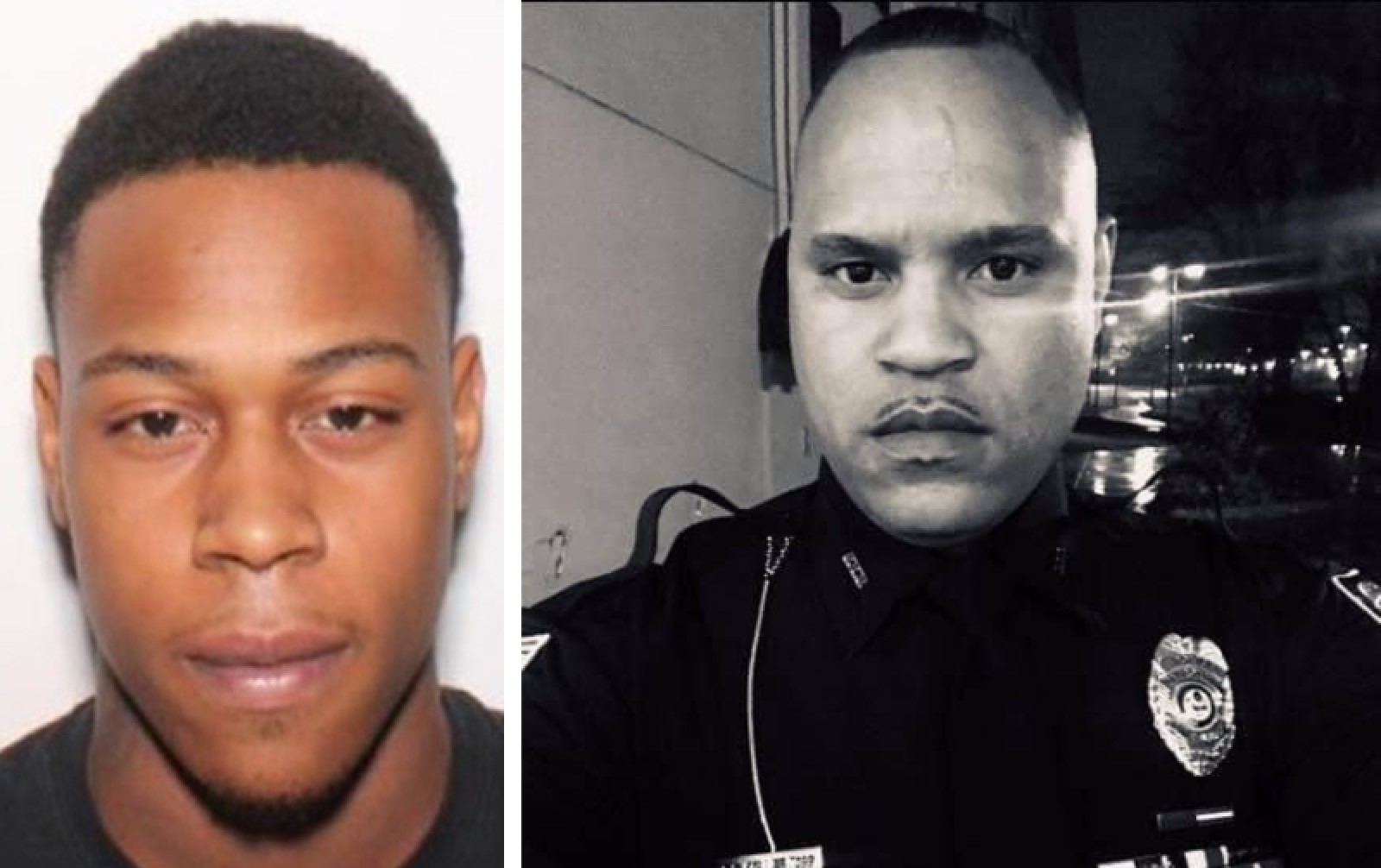
Lawyers in KeShone Smith’s capital murder trial delivered closing arguments Thursday after a former Pine Bluff police officer who was involved in a 2020 shootout that killed his partner Kevin D. Collins took the stand.
Thursday was the fourth day of the trial. Smith, now 23, is charged with capital murder of a police officer, first-degree battery of police Lt. Ralph Isaac and first-degree battery of Dave Wright, a witness in a vehicle with Smith at the time of the Oct. 5, 2020, shootout at the Econo Lodge Motel. Smith declined to testify upon advice of his attorney, Lee D. Short.
The jury of seven men and five women will reconvene in Judge Jodi Dennis’ 11th West Circuit Fifth Division courtroom to begin deliberations at 9 a.m. today. Dennis instructed the jury they can find Smith guilty of either capital murder, which carries a sentence of life imprisonment without the possibility of parole (attorneys agreed to remove the death penalty as an option); first-degree murder, which carries a sentence of 10 years to life; or acquit him.
To find Smith guilty of either level of murder is to find him guilty of the two battery charges as well, Dennis added.
Independent reporting for Pine Bluff & Jefferson County since 1879.
Short confronted Kelsey Collins, now a traffic division corporal in the Bentonville Police Department, after he testified that his mind changed about when and where he fired shots during the shootout. Kelsey Collins, who said he didn’t know for sure when asked if he was of any relation to Kevin Collins, said he had not heard of Smith, whom police were searching for on felony warrants out of Georgia, before Kevin Collins called him that morning and told him they were “going on a mission” to locate Smith at the motel.
Kelsey Collins testified he and Kevin Collins traveled in a department-issued, unmarked black Dodge Charger to get gas before heading to the motel. Traveling in an unmarked vehicle, he said, was a standard operation in the Pine Bluff Police Department to keep a low profile in warrant searches, as was not having dashcam video in the vehicle or body cameras at the time.
Fielding questions from deputy prosecuting attorney Karres Manning, Kelsey Collins explained that Kevin Collins, a PBPD detective at the time of his death, jumped out of his vehicle as quickly as possible once they pulled up at the motel and shouted “Police! Show me your hands!” Kelsey Collins also testified that he saw a scuffle near the passenger right-rear door of a red Charger that Smith is said to have dived into with Wright, Kirel Young and DeAndre Gates inside.
“Kevin is trying to get the guy to turn around and put his hands in the back,” Kelsey Collins told Manning, noting Smith had his hands outside the window at first. “I saw a gun in front of me in the backseat, and it was pointed at me.”
Asked what he saw next, Kelsey Collins described “a ball of fire” as Kevin Collins was right beside him.
“I stood up, returned fire and saw Kevin crawling toward me,” Kelsey Collins said.
Visibly overcome with emotion, Kelsey Collins paused for about two minutes as he explained that Kevin Collins tried several times to get up but succumbed due to the last shot he took. Kelsey Collins said he stood over his fallen partner and called for assistance.
The defense alleged Kelsey Collins fired the first shots to begin the shootout. According to testimony from Wright and Young on Wednesday, police fired first and Young sustained a wound just below the middle finger of the palm of his right hand.
Kelsey Collins said Thursday his “mind was everywhere” and his “mental state wasn’t good” when he said in three different recorded statements since 2020 he was firing toward Smith at close range. Seeing video of the incident recently, he said, changed his mind from that statement to firing about 15 feet away from the red Charger near the police-issued black Charger. Testimony from state Crime Laboratory officials earlier Thursday pointed to 11 pieces of ammunition fired by Kelsey Collins.
Short took Kelsey Collins to task for the change in the statement, contending that police used excessive force and Smith was justified in firing back at officers in self-defense.
Short accused investigators of deciding what happened before talking to officers to gather information for a submission form to the crime lab, alluding to Kelsey Collins’ belief that police were shot at first before returning fire.
“Kirel Young didn’t change his story,” Short told the jury in his closing argument, pointing out neither he nor Wright wanted to testify. “There’s no doubt [Young] wasn’t here for KeShone. He’s just telling what happened exactly the day of the incident. [Young’s] attitude gives no credibility.
“Dave Wright isn’t friends with KeShone. He said, ‘I didn’t know who shot me.’ There’s only one consistent thing Kelsey said: [Smith] shot first. The problem is, it depends on who shot Kirel Young. There’s no way [Kelsey Collins] is telling you the truth. He grabbed a mythical guy in the backseat. You have no idea what’s going on in that car based on the video.”
In her closing argument, Manning recalled a time when she grew up in a household with one floor-model television set and her father would watch a Western series when he was home.
“Marshal Matt Dillon had to go out and find wanted men,” Manning said, referring to the “Gunsmoke” protagonist played by James Arness. “There are still men like Marshal Dillon. That’s what Kevin Collins did. He went out and found wanted men.”
Smith’s desperation to avoid apprehension, Manning continued, led to his shooting and killing Kevin Collins.
Prosecutors gained a small victory Thursday when Dennis rejected a motion from Short to direct a verdict on the three counts. Short argued the state didn’t provide evidence that Smith killed Kevin Collins in a premeditated and deliberate manner, as the prosecution must prove in a capital murder trial.